

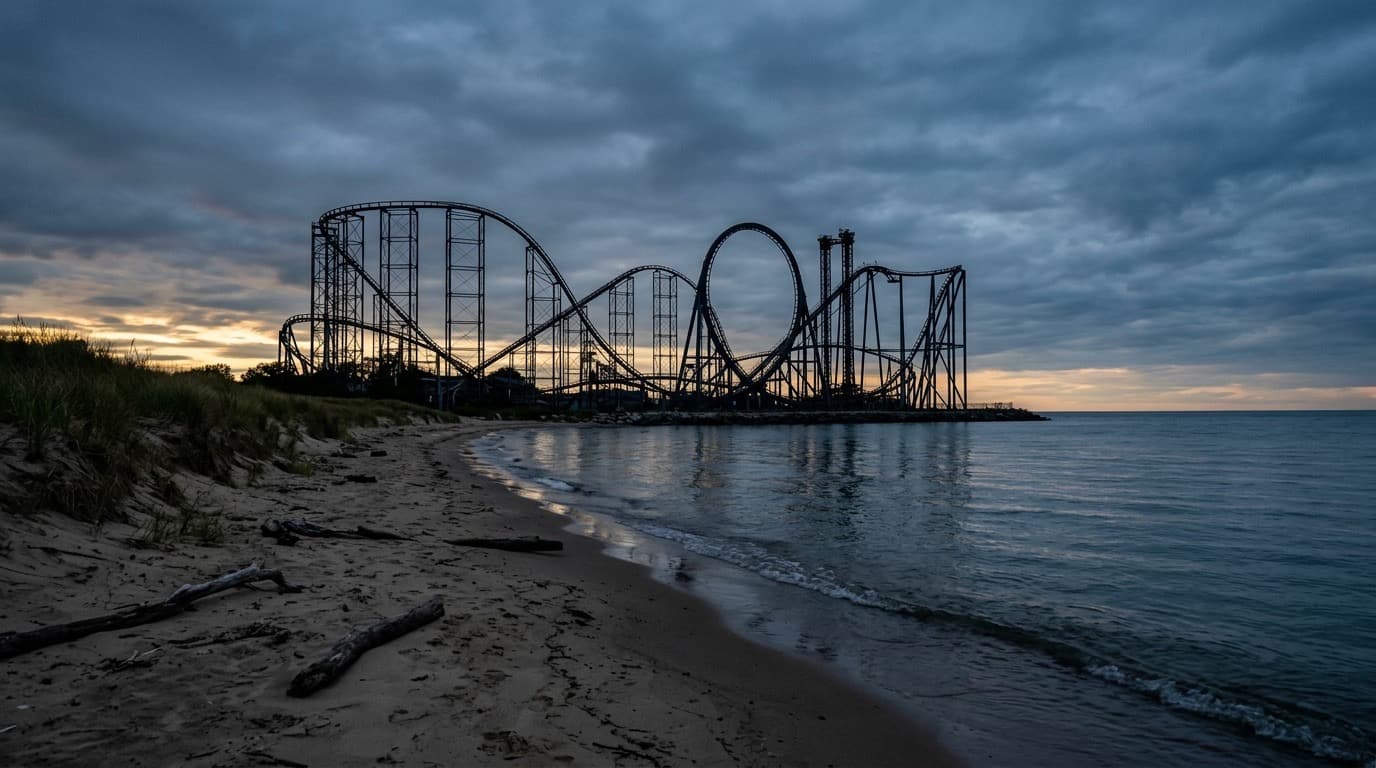
Hurt at Cedar Point, Kings Island, or Cedar Point Shores? Our attorneys analyze coaster, restraint, water-park, and premises claims under Ohio law. Free review.
Cedar Point is in Sandusky on Lake Erie, and Kings Island is near Cincinnati. If you were injured at either park or a nearby water attraction, identify the specific location, ride or area, and incident date. That information helps direct the evidence and Ohio-law review.
This page explains how injury claims at Cedar Point properties generally work under Ohio law: what the statute of limitations is, how Ohio’s comparative negligence rule operates, what Ohio’s amusement ride safety regulator does, how waiver enforceability cuts in this state, and what to do in the first days after an incident.
Request a Free Case ReviewCall 833-236-8253
The Cedar Point and Ohio Park Footprint
Cedar Point and Kings Island were operated for decades by Cedar Fair, L.P., a publicly traded limited partnership headquartered in Sandusky, Ohio. In 2024, Cedar Fair completed a merger with Six Flags Entertainment Corporation, and the combined company now operates under the Six Flags Entertainment Corporation name, headquartered in Charlotte, North Carolina, with finance and administrative operations in Sandusky, Ohio. Day-to-day, the legacy Cedar Fair parks continue to operate under their established park brands (Cedar Point, Kings Island, and others) and the Ohio properties continue to be governed by Ohio law.
For Ohio-injured guests, this matters in three concrete ways:
- Ohio law governs the claim. A guest injured at Cedar Point in Sandusky or at Kings Island in Mason is governed by Ohio’s substantive law, regardless of where the parent corporation is headquartered.
- The corporate defendants are usually identifiable. A typical complaint names the operating LP or LLC for the specific park, plus the parent corporation, plus any manufacturer or contractor whose conduct contributed to the injury.
- 3. Identify the records custodians and potentially relevant insurance information for the specific operating entity. Do not assume the location of a parent company determines document custody or venue.
Ohio properties most commonly at issue:
- Cedar Point (Sandusky): the park includes roller coasters and other attractions, a beachfront and a marina. Identify the specific attraction and incident date when requesting an injury review.
- Cedar Point Shores: the on-property water park adjacent to Cedar Point.
- Kings Island (Mason, near Cincinnati): Ohio’s other major theme park, with a separate roller coaster collection and Soak City, its on-property water park.
- Castaway Bay and Cedar Point Hotel Breakers: the on-property resort and lodging properties at Cedar Point.
If you were injured at any of these properties, the analysis below applies.
Common Injury Scenarios at Cedar Point and Kings Island
A review of an incident at Cedar Point or Kings Island starts with the specific ride or property area, what happened and the available records. The examples below describe questions that may arise; they do not establish a safety history or finding of fault at either park.
Roller Coaster Mechanism Failures
If a coaster incident suggests a mechanical or operational issue, potential questions for a ride-specific investigation include:
- Restraint anomalies: over-the-shoulder harnesses, lap bars, ratchet failures, or seat belts that do not engage properly or are not visually verified at dispatch
- Brake or block-zone failures producing unintended train-to-train contact
- Track or structural issues producing unexpected lateral loads or rough rides
- Wheel and chassis failures including flat spots, polyurethane separation, or bearing failures
- Control system errors at dispatch: train sent before all guests are properly secured, or before the previous train has cleared the next block
These mechanism-level questions are at the center of most coaster cases. We cover the engineering and legal theories on our roller coaster accident claims hub.
Restraint and Ejection Injuries
Drop towers and high-speed coasters depend on restraint systems calibrated for a wide population of guest body sizes. When a restraint is not engaged, is engaged at the wrong click, is not visually verified, or is mismatched to a particular guest’s geometry, the result can be catastrophic. The legal theory crosses both operator negligence (verification, training, dispatch protocol) and manufacturer liability (restraint design, warning adequacy, signage). For deeper analysis, see our drop tower restraint failure liability page.
Water Park Injuries at Cedar Point Shores and Kings Island Soak City
Water park claims raise a separate set of issues:
- Drowning and near-drowning in wave pools, lazy rivers, and activity pools
- Water slide injuries at slide exits, mid-slide collisions when dispatch intervals are mismanaged, and structural separations
- Lifeguard supervision: staffing ratios, scanning patterns, and response time
- Slip and fall on wet decks, stair towers, and locker rooms
- Recreational water illness from chemical imbalance or contamination
We cover these in detail on our water park accident attorney page.
Premises, Queue, and Parking Lot Incidents
A meaningful share of intake calls involve injuries that did not happen on a ride at all:
- Slip, trip, and fall on midway walkways, especially near food and beverage outlets and water-feature splash zones
- Queue line incidents: falls in switchback queues, struck-by events from temporary fencing
- Parking lot and tram incidents: pedestrian-vs-vehicle, lighting-related falls
- Dock and marina incidents at Cedar Point’s lakefront properties
- Hotel and resort property injuries at Hotel Breakers, Castaway Bay, or Cedar Point’s other lodging
- Concession and food-borne illness claims, including allergen exposure from undisclosed ingredients
- Heat and cold weather medical events: relevant in both summer extremes and shoulder-season operating days, where Lake Erie weather can shift abruptly
Talk to an attorney about your caseCall 833-236-8253
Who Can Be Held Liable in a Cedar Point or Kings Island Case
Most serious park injury cases involve multiple defendants. Identifying them all early is one of the most important things an experienced firm does.
The Park Operator
The operating entity for the specific park is usually the lead defendant. Theories include:
- Negligent operation: dispatch, restraint verification, lifeguard supervision
- Negligent maintenance: failure to follow manufacturer service intervals
- Negligent inspection: failure to detect a known or knowable defect
- Negligent hiring, training, and supervision of ride operators and lifeguards
- Premises liability for non-ride hazards
- Failure to warn of medical contraindications adequately conveyed at the queue and on the ride
The Ride Manufacturer or Designer
Cedar Point’s and Kings Island’s coaster collections are built by a small group of manufacturers: names like Bolliger & Mabillard, Intamin, Mack Rides, Premier Rides, Vekoma, Arrow Dynamics legacy installations, and Great Coasters International. When an injury results from a design choice (restraint geometry, calculated G-loading, structural fatigue, or control-system logic), the manufacturer can be a co-defendant under product liability theory. Ohio’s product liability statute (R.C. 2307.71 through 2307.80) provides the framework.
Maintenance, Inspection, and Component Vendors
Cedar Point’s operation relies in part on outside vendors for non-destructive testing, control system service, and specialized component work. If a contracted inspector cleared a component that should have been pulled from service, that vendor can be a separate defendant.
Concessionaires, Lifeguard Staffing Vendors, and Third Parties
Some food, retail, and game concessions inside the gate are operated by third-party tenants. Some water park lifeguard programs are run with vendor support. Their negligence is independently actionable.
Insurance Carriers
Your direct adversary is almost always an insurance carrier rather than a park spokesperson. A park of Cedar Point’s scale carries a layered insurance program. The presentation, sequencing, and documentation expected by carrier counsel is specific.
Ohio’s Legal Framework for Park Injury Claims
Most of the analytical heavy lifting in a Cedar Point case happens under Ohio law. The framework breaks down into a few core doctrines.
Comparative Negligence: The 50% Bar
Plaintiff contributory fault may equal but must not exceed combined tortious conduct of all other persons, including those not sued; proportionate compensatory-damage reduction. Under R.C. 2315.33:
- If your share of fault is 50% or less, you can recover, with your damages reduced by your percentage of fault.
- Plaintiff contributory fault may equal but must not exceed combined tortious conduct of all other persons, including those not sued; proportionate compensatory-damage reduction.
Ohio R.C. 2315.33 bars recovery when the claimant’s contributory fault exceeds the combined tortious conduct of all other persons. Otherwise compensatory damages are reduced proportionately. A claimant 50% at fault is not barred by this rule.
Statute of Limitations
Ohio ordinary bodily-injury actions generally have two years from accrual, normally when injury occurs, under R.C. 2305.10. Wrongful-death actions generally have two years after death under R.C. 2125.02(F)(1). Statutory discovery, disability and products-repose rules can affect the analysis; get the specific deadline checked promptly.
Ohio ordinary bodily-injury actions generally have a two-year period under R.C. 2305.10 and wrongful death generally two years after death under R.C. 2125.02. Check the relevant accrual, tolling and repose rules; do not assume every latent injury receives delayed discovery or every minor’s death claim receives minority tolling.
For a fuller cross-state comparison, see our statute of limitations by state reference.
Ohio’s Amusement Ride Safety Law
Ohio regulates fixed-site amusement rides through the Ohio Department of Agriculture, Division of Amusement Ride Safety under R.C. Chapter 1711, which includes the Advisory Council on Amusement Ride Safety (often called “ACARS”). Key features:
- All amusement rides operated for the public must be registered and inspected.
- Rides are issued a permit to operate after inspection.
- Operators are required to report serious injuries and incidents to the Department.
- The Department maintains records of inspections, incidents, and corrective actions.
These records are critical evidence in any Cedar Point case. Public-records requests are sent to the Ohio Department of Agriculture early in the investigation.
Damages Caps in Ohio
For tort actions covered by Ohio Rev. Code § 2315.18, economic loss is not limited by that section. Subsection (B)(2) generally limits noneconomic loss to the greater of $250,000 or three times economic loss, subject to $350,000 per plaintiff and $500,000 per occurrence. Subsection (B)(3) removes that noneconomic limitation for its specifically defined permanent injuries; it does not substitute a higher $500,000/$1 million cap. Subsection (H) excludes wrongful-death and specified governmental actions. Whether an exception applies requires review of the claim and medical evidence. Read the controlling statute.
Ohio Revised Code§ 2315.18 does not apply to wrongful-death actions brought under Chapter 2125. Wrongful-death damages instead must satisfy§ 2125.02 and any other applicable claim-specific law. Source 1 Source 2
Waivers and Assumption of Risk
Ohio courts generally enforce clearly drafted, conspicuous waivers of ordinary negligence in recreational contexts. However, Ohio courts will not enforce waivers as to:
- Willful, wanton, or reckless conduct
- Applicable statutory safety duties require separate analysis.
- In some contexts, claims involving minors signed by parents (the law in this area is mixed and fact-dependent)
A waiver in your ticket terms or season pass is not a reason to assume your case is over. It is a reason to talk to a lawyer about the specific language and the specific facts. See our waiver enforceability by state reference.
“Inherent Risk” of Amusement Rides
Like many states, Ohio recognizes that some risks are inherent in amusement park attractions. That doctrine does not immunize an operator from negligence; it simply means the operator is not a guarantor of safety. An injury caused by a mechanical failure, a restraint failure, an operator dispatching a train without verification, or a slide attendant ignoring spacing intervals is not an “inherent risk” of the activity. It is a question of fault.
Request a Free Case ReviewCall 833-236-8253
How Cedar Point Ticket and Membership Terms Affect Your Claim
When you buy a ticket, a Gold Pass, a Prestige Pass, or another membership product, you agree to a set of terms. Common features include:
- An assumption-of-risk acknowledgment for inherent risks of amusement park attractions
- A waiver and release of certain negligence-based claims
- Current Six Flags ticket/pass terms require separate review of the park location, product and accepted version. Ohio is not a universal dispute forum; the current terms tie ordinary in-person arbitration to the park county, subject to their exceptions.
- Current Six Flags terms include arbitration and class-action provisions with exceptions; review the product/location addenda and accepted version.
- A notice-of-claim procedure with short timelines
Critical points for guests:
- Waivers do not bar claims for willful, wanton, or reckless conduct in Ohio.
- Waivers generally do not bar product liability claims against the manufacturer of a defective ride component.
- Forum selection clauses are usually enforceable, but they only change where the case is heard.
- Check the season-pass terms applicable to the incident for any notice, filing, forum or arbitration provision, and obtain advice about its validity before assuming a claim is barred.
Evidence Preservation: The First 72 Hours
Cedar Point and Kings Island generate enormous quantities of evidence, but most of it is controlled by the park and its vendors, and most of it has a short shelf life. The single biggest mistake injured guests make is waiting weeks before contacting a lawyer.
What we move quickly to preserve:
- Maintenance and inspection logs for the specific ride or attraction
- Operator schedules and training records for the staff working the attraction that day
- Ride control system data: PLC logs, dispatch timestamps, e-stop records
- Surveillance video from queue cameras, station cameras, and area cameras (often overwritten on a 14- to 30-day cycle)
- On-ride photo and video automatic capture systems
- Incident report and EMS run sheets
- Witness statements while memory is fresh
- The physical component itself if a mechanical failure is suspected
- Public records from the Ohio Department of Agriculture, Division of Amusement Ride Safety, including inspection records, permits to operate, and any incident reports filed by the operator
A formal letter of preservation sent to the park within days of the incident creates a duty to retain this material.
For a step-by-step guest checklist, see our evidence preservation checklist and our what to do after a park injury guides.
Industry Safety Context
IAAPA publishes aggregate fixed-site ride safety reports for participating operators. Industry estimates do not establish the risk at a particular park or determine whether negligence caused a specific injury. Use the identified report year, population and definition of injury when interpreting safety statistics. IAAPA Safety Reports
For a park system the size of Cedar Point, with millions of annual visits and hundreds of millions of rides taken across decades of operation, the math means that even a low-rate event class will produce an ongoing case stream. That is why a developed body of law, a developed body of engineering standards (ASTM F24 governs amusement rides; ASTM F2376 and F2461 govern aquatic features), and a developed playbook exist for handling these cases.
Wrongful Death at Cedar Point or Kings Island
A wrongful-death action is brought in the decedent’s personal representative’s name for the statutory beneficiaries under R.C. 2125.02(A), including the spouse, children, parents and other next of kin, subject to statutory conditions. Recoverable damages depend on the categories and proof required by subsection (D). Source 1
- Loss of support from the reasonably expected earning capacity of the decedent
- Loss of services
- Loss of society: companionship, consortium, care, assistance, attention, protection, advice, guidance, counsel, instruction, training, and education
- Loss of prospective inheritance
- Mental anguish of the surviving family
A separate survival action under R.C. 2305.21 can recover the decedent’s pre-death pain and suffering and economic losses up to the date of death.
For deeper treatment, see our wrongful death damages in theme park cases analysis.
How Our Firm Approaches Cedar Point and Kings Island Cases
Cases involving large Ohio park operators are not won by the lawyer who files the loudest demand letter. They are won by the firm that:
- Moves fast to preserve evidence before it ages out, including public records requests to the Ohio Department of Agriculture in the first days.
- Identifies every potential defendant (operator, manufacturer, maintenance vendor, inspector, concessionaire) and builds a coordinated theory.
- Retains the right experts early: ride engineering, accident reconstruction, biomechanics, life-care planning, vocational economics.
- Knows the Ohio damages framework: what the cap does and does not apply to, when wrongful death analysis takes a case outside the cap, and how to document economic damages.
- Coordinates with Ohio counsel, who prepares the case for trial in the proper Ohio venue from day one.
An initial inquiry helps identify the incident, injury and available records. Further investigation may be needed before discussing Ohio law and potential responsibility. There is no fixed consultation duration or promise that the initial conversation will establish whether a claim is viable.
Request a Free Case ReviewCall 833-236-8253
Free Cedar Point Case Evaluation
Ohio ordinary bodily-injury claims generally have a two-year limitation. Have counsel check the applicable deadline and preserve relevant evidence promptly.
If you or a family member was injured, or you lost a loved one, you can request a free case review. Start with the location, approximate date and a brief summary. Evidence and legal deadlines can be time-sensitive. An inquiry does not create an attorney-client relationship; avoid sensitive documents until a secure follow-up is arranged.
Request your free case evaluation | Call our intake line
For Ohio-specific legal context, see our Ohio state hub.
Attorney Advertising. Prior results do not guarantee a similar outcome. The information on this page is general legal information, not legal advice for your specific situation. Reading this page does not create an attorney-client relationship. “Cedar Point,” “Kings Island,” “Cedar Point Shores,” “Soak City,” and related marks are used here for nominative reference only; this firm is not affiliated with, endorsed by, or sponsored by Six Flags Entertainment Corporation or its operating subsidiaries.
Frequently Asked Questions
Ohio ordinary bodily-injury actions generally have two years from accrual, normally when injury occurs, under R.C. 2305.10. Wrongful-death actions generally have two years after death under R.C. 2125.02(F)(1). Statutory discovery, disability and products-repose rules can affect the analysis; get the specific deadline checked promptly.
Not automatically. Ohio enforces clear waivers for ordinary negligence, but waivers do not bar claims for willful, wanton, or reckless conduct, and they generally do not bar product liability claims against the ride manufacturer. The specific waiver language and the facts of your incident must both be reviewed.
Ohio uses a modified comparative-fault rule with a more-than 50% bar. Under R.C. 2315.33, plaintiff fault does not bar recovery when it is no greater than the combined tortious conduct of all other persons, but recoverable compensatory damages are reduced proportionately. Other elements and defenses still must be satisfied.
Ohio Rev. Code § 2315.18 generally limits noneconomic damages in covered tort actions. Subsection (B)(3) removes that limitation for specifically defined permanent injuries; it does not merely raise the cap. Economic loss is not limited by this section, and subsection (H) excludes wrongful-death and specified governmental actions. The claim type and medical evidence determine the applicable analysis.
Cedar Point and Kings Island claims require separate incident-specific reviews. Ohio law may be relevant, but identify each responsible entity, attraction, claim, contract and deadline. Do not assume an identical legal or evidence analysis.
Ohio law governs the substantive claim because that is where the injury occurred.
Get medical care. Then preserve evidence: photograph the scene, save your tickets and receipts, request a copy of the incident report, write down witness names and contact information, and call a lawyer before talking to the park's claims department. See our what to do after a park injury guide.