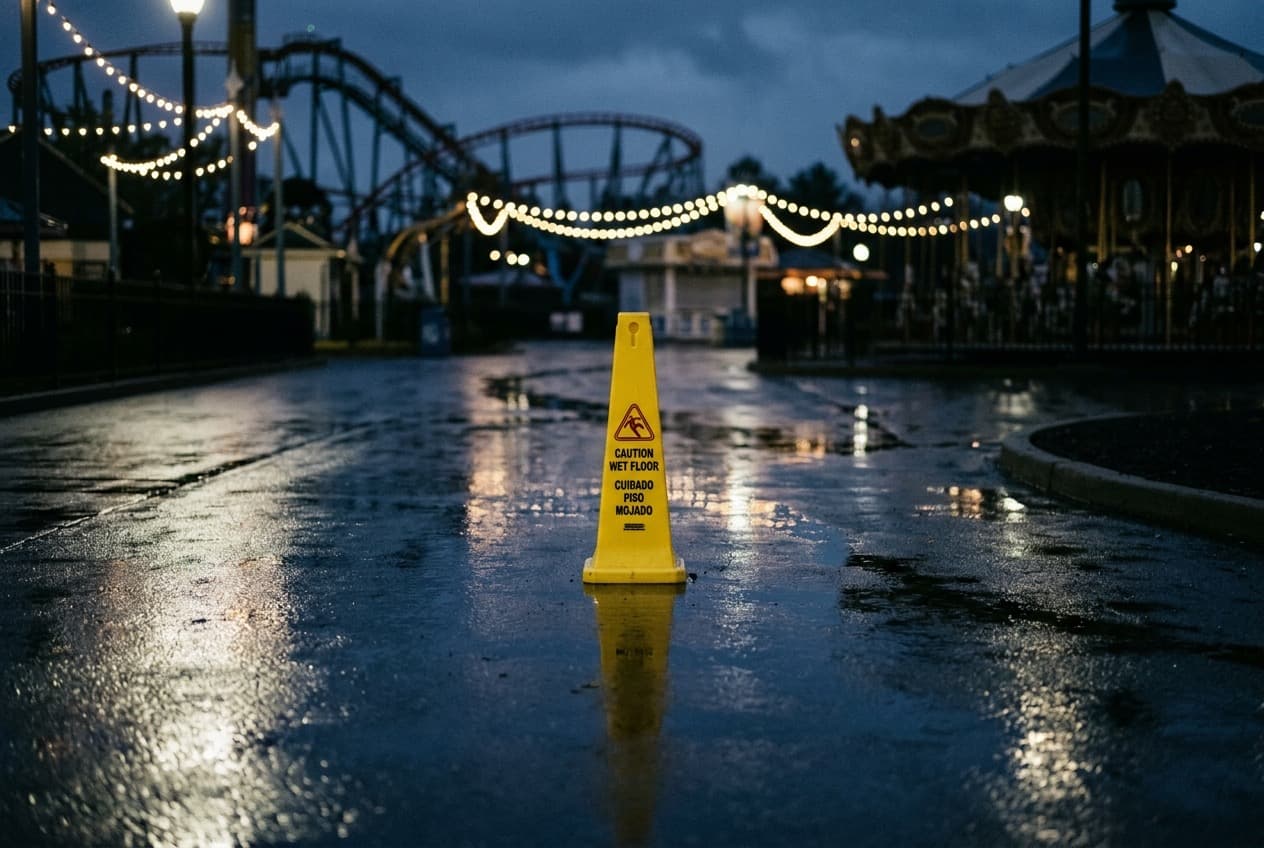
A day at an amusement park is supposed to be safe. Operators advertise it that way. They have inspectors, ride engineers, and posted safety signs. When something goes wrong, the harm is rarely minor. A failed restraint, a wet pavement near a queue line, a drop tower that overshoots its braking zone, or a lifeguard who looks away at the wrong moment can change a person’s life in seconds.
Our attorneys review claims for people and families across the country who were hurt at amusement parks, working with local counsel where required. We review ride incidents, premises injuries, and wrongful death claims. This page explains what an amusement park injury claim actually is, who can be held responsible, and how the legal process works. If you want to talk through your situation, you can request a free case review at any time.
Injury vs. Accident: What “Amusement Park Injury Claim” Really Covers
People often use the words “injury” and “accident” interchangeably. In legal practice, they describe slightly different parts of the same problem. An “accident” is an event. An “injury” is the harm that follows. The framing matters because most amusement park injury claims do not turn on whether something happened. The park’s incident log, ride telemetry, and witness statements usually establish that. They turn on whether the harm was foreseeable and preventable, and whether someone in the chain of responsibility failed a duty of care that caused the harm.
An amusement park injury claim can include any of the following circumstances:
- A guest hurt while riding a ride, regardless of whether the ride mechanically failed
- A guest injured while boarding, exiting, or queuing for a ride
- A guest injured on park premises with no ride involved (a fall, a structural failure, a transportation injury)
- A guest harmed by food, allergens, or contaminated water
- A guest who suffered a delayed medical event (cardiac, embolic, neurologic) that emerged after a ride
- A family pursuing wrongful death damages after a fatal incident
The legal theories that support these claims overlap but are not identical. Ride incidents can sound in negligence, premises liability, product liability, or all three at once. A drowning at a wave pool can be a lifeguard supervision claim, a design claim against the wave system manufacturer, or both. Identifying every viable theory and every potentially responsible defendant early is one of the most important pieces of work an attorney does on a park injury case.
Common Injury Categories at Amusement Parks
Park injuries cluster into recognizable patterns. The U.S. Consumer Product Safety Commission (CPSC) tracks fixed-site and mobile amusement ride injuries through its National Electronic Injury Surveillance System (NEISS). Aggregate NEISS and CPSC data, along with industry reporting from IAAPA and ASTM committee filings, point to the following injury categories appearing again and again.
Traumatic Brain Injuries from Ride Forces
Reported head or body impacts can raise concerns about concussion or other injuries. CDC explains that some concussion symptoms appear immediately and others hours or days later. A healthcare professional should assess symptoms and medical causation; this guide is general information, not a diagnosis or medical advice. CDC Concussion Guidance
Spinal Cord and Neck Injuries
Cervical disc herniation, vertebral fracture, and in serious cases spinal cord injury can result from sudden direction changes, restraint failure that allows excess movement, or seat designs that fail to support a rider’s posture during high-G sections. Some riders never recover full function. Long-term care needs often dominate damages calculations in these cases.
Orthopedic Injuries (Fractures, Dislocations)
Loading-area falls, abrupt stops, and ejection events can produce fractures and dislocations of the shoulder, wrist, hip, knee, and ankle. Older riders and children are disproportionately represented in this category.
Soft Tissue and Whiplash Claims
Many ride-related injuries do not appear on imaging. Soft tissue damage, ligamentous injury, and post-concussion syndrome are real, disabling, and compensable. Claims involving these injuries require careful documentation, consistent treatment records, and often expert testimony to overcome the defense argument that the injury “wasn’t really there.”
Drowning and Near-Drowning at Water Attractions
Drowning can be fatal or nonfatal. CDC describes a range of nonfatal outcomes, from no injury to brain damage or permanent disability. Medical records and qualified medical assessment are needed to understand the injury in a particular incident. This is general information, not medical advice. CDC Drowning Facts
Burns, Lacerations, and Amputations
Mechanical contact with moving ride parts, friction burns from slide surfaces, and chemical burns from improperly treated pool water all appear in the injury record. Amputations are rare but documented, typically arising from extremity contact with mechanical components on coasters and water rides.
Who Can Be Held Liable for Amusement Park Injuries
A common mistake injured guests make is assuming the park is the only defendant. In most serious cases, multiple parties contributed to the harm. Identifying every responsible party expands the recovery available and strengthens leverage during settlement negotiation.
Park Operators
The park itself owes guests a duty of reasonable care. In most states this includes the duty to inspect the premises, train staff, follow manufacturer maintenance schedules, post adequate warnings, and operate rides within their certified parameters. When a park cuts a ride’s required inspection, ignores a manufacturer service bulletin, or assigns an undertrained operator to a complex attraction, that conduct can support a direct negligence theory.
Ride Manufacturers and Designers
Rides are products. They are designed, engineered, manufactured, and sold. When a design defect, a manufacturing defect, or a failure to warn causes injury, the manufacturer can face product liability exposure. Manufacturers in this space include companies such as Intamin, Bolliger & Mabillard (B&M), Mack Rides, Premier Rides, S&S Worldwide, Vekoma, and others. Product liability claims are usually pursued in parallel with operator negligence claims rather than instead of them.
Maintenance and Inspection Contractors
Most parks outsource at least some maintenance and inspection work to specialty contractors. When a contractor signs off on a ride that should not have been cleared, or fails to follow a documented service procedure, the contractor’s negligence can be a direct cause of the injury. These contractors carry their own liability policies, which is a meaningful consideration in serious cases.
Concessionaires and Third-Party Vendors
Food vendors, costumed character contractors, transportation operators, and games concessionaires often operate inside parks under license. When a concession is the source of the harm (food poisoning, allergen exposure, equipment defect at a games stand), the concessionaire and the park may share responsibility under premises liability and joint venture theories.
Damages You Can Recover
Recoverable losses may include proven medical expenses, lost earnings or earning capacity, and permitted noneconomic harm. The categories and amount depend on causation, evidence and governing law.
Recoverable categories typically include:
- Past and future medical expenses, including rehabilitation and long-term care
- Past and future lost earnings and lost earning capacity
- Pain and suffering
- Loss of enjoyment of life
- Permanent disability and disfigurement
- Loss of consortium for spouses
- Wrongful death damages where applicable, including loss of support, loss of services, and loss of companionship
Wrongful death damages vary significantly by state. wrongful death damages in theme park cases explains the framework in more detail, including how courts handle damages for survivors of decedents who were children at the time of the incident.
Punitive damages may be available under the governing state’s conduct, proof, pleading and vicarious-liability rules. Review the actual pre-incident conduct and evidence against those requirements.
How We Evaluate What Happened and Your Injuries
A review starts with two questions: what happened at the park, and how were you injured? Keep the incident date, exact location, tickets, photographs, witness contacts and any report number. Medical records help connect the reported event to the injury and treatment.
The legal review considers potential responsibility, available evidence, ticket terms, injury documentation and deadlines. An incident report or an injury alone does not establish liability. The next step depends on the facts; requesting a review is not a promise of representation or recovery.
For a different angle on the same body of work, the home page covers the firm’s broadest commercial intake. The theme park accident attorney page focuses on theme park properties specifically. water park accident attorney concentrates on water park mechanisms. roller coaster accident claims addresses coaster-specific liability theories.
How We Build Amusement Park Injury Cases
Every case starts with the question of what evidence still exists and what is at risk of disappearing. Park CCTV footage is often retained for as little as 30 days. Ride telemetry data may be overwritten on a similar schedule. Witness memory degrades. Physical evidence at the scene gets cleaned, replaced, or repaired in the normal course of operations.
Our standard intake on a serious injury or wrongful death case includes:
- Immediate spoliation letters to the park operator, ride manufacturer, and known maintenance contractors, demanding preservation of CCTV, ride logs, maintenance records, and incident reports.
- State agency records requests under the relevant ride-safety regulator (Florida DOACS, California DOSH, Texas Department of Insurance, Ohio Department of Agriculture, New Jersey DCA, and others depending on jurisdiction).
- CPSC public records requests and review of any CPSC submissions involving the ride model.
- Retention of qualified experts: ride engineering, biomechanics, human factors, and life-care planning as the case requires.
- Comprehensive medical record review and coordination with treating providers to ensure the injury record captures every consequence of the incident.
- Statute of limitations docketing under the law of every potentially applicable state. Time limits vary widely; details are at statute of limitations by state.
We do not file complaints reflexively. Many cases resolve before filing. Whether a case should be filed and where depends on jurisdictional analysis, the strength of the evidence package, and the defendant’s willingness to engage seriously in pre-suit negotiation.
What to Do If You Were Injured at an Amusement Park
The most consequential decisions about an injury claim are often made in the first 72 hours after the incident. If you are reading this in that window, the priority is medical care. After that, the practical steps that protect a future claim include:
- Photographing the scene, your injuries, and any relevant equipment if you can do so safely
- Obtaining the names and contact information of any witnesses
- Filing an incident report with the park and getting a copy
- Saving your tickets, receipts, and any wristbands or RFID tags
- Preserving the clothing and footwear you were wearing if there is any chance they are evidence
- Not signing anything the park puts in front of you without legal review
- Not posting about the incident on social media, including the platforms where the park itself may be posting
Calling counsel early matters because spoliation letters need to go out before retention windows close. Park risk managers and their insurers move quickly. Our contact page lists ways to reach us. We respond to serious injury inquiries within one business day.
Frequently Asked Questions
What Is the Statute of Limitations on an Amusement Park Injury Claim?
The deadline depends on the claim, governing law, accrual and defendant. For example, ordinary personal injury generally has a three-year period in New York; Florida ordinary negligence currently has a two-year period subject to the 2023 transition. Public-entity notice rules can be much shorter.
Can I Sue If I Signed a Waiver When I Bought My Ticket?
Often, yes. Waivers vary widely in enforceability. Some states (notably New York under General Obligations Law § 5-326) sharply restrict the enforceability of recreational facility waivers. Others enforce them more readily but still refuse to enforce waivers covering gross negligence, reckless conduct, or intentional torts. Whether a specific waiver bars a specific claim is a question to put to an attorney who has reviewed the actual waiver text.
How Long Does an Amusement Park Injury Case Take?
Many injury cases resolve without trial, but timing and outcome depend on the facts. Catastrophic injury and wrongful death cases that proceed through filing and discovery often run longer, sometimes two to four years. Routine premises cases can resolve faster. The single biggest variable is the willingness of the defendant’s insurer to engage realistically in negotiation before filing forces them to.
Do I Have to Travel Back to the State Where I Was Injured?
Often, no. Many out-of-state plaintiffs handle most of their case remotely. Depositions can sometimes be taken near your home. Mediations are increasingly conducted by video. Travel is more likely if the case proceeds to trial. Many injury cases resolve without trial, but timing and outcome depend on the facts.
What If My Child Was Injured?
A child’s claim needs prompt, separate review of filing and notice deadlines, legal representation and settlement-approval requirements. A parent’s related claim may have a different deadline. Future-care and earning-capacity losses require proof under the governing law.
How Much Does It Cost to Hire an Amusement Park Injury Attorney?
No Win, No Fee. Your first case review is free.
What If the Park Says the Incident Was My Fault?
Rider or third-party conduct can affect breach, causation, assumption of risk and allocation. Comparative-fault jurisdictions include recovery bars and exceptions; pure comparative fault does not guarantee recovery if another element fails or the plaintiff alone caused the harm. Whether the rider followed every posted instruction, whether the warnings were adequate, and whether the operator’s conduct was independently negligent are all separate questions.
Free Case Evaluation
If you or a family member was hurt at an amusement park, you can request a free case review with our firm. There is no charge to talk and no obligation to retain us. Visit our case evaluation page or reach out through our contact page. For background on the firm and our attorneys, see our About page.
Attorney Advertising. Prior results do not guarantee a similar outcome. The information on this page is for general educational purposes and is not legal advice. Reading this page does not create an attorney-client relationship. For advice on your specific situation, consult an attorney licensed in your jurisdiction.