

A legal analysis of drop tower and freefall ride restraint failures: design standards, operator liability, manufacturer liability, and damages.
free case review →
How Drop Towers and Freefall Rides Work
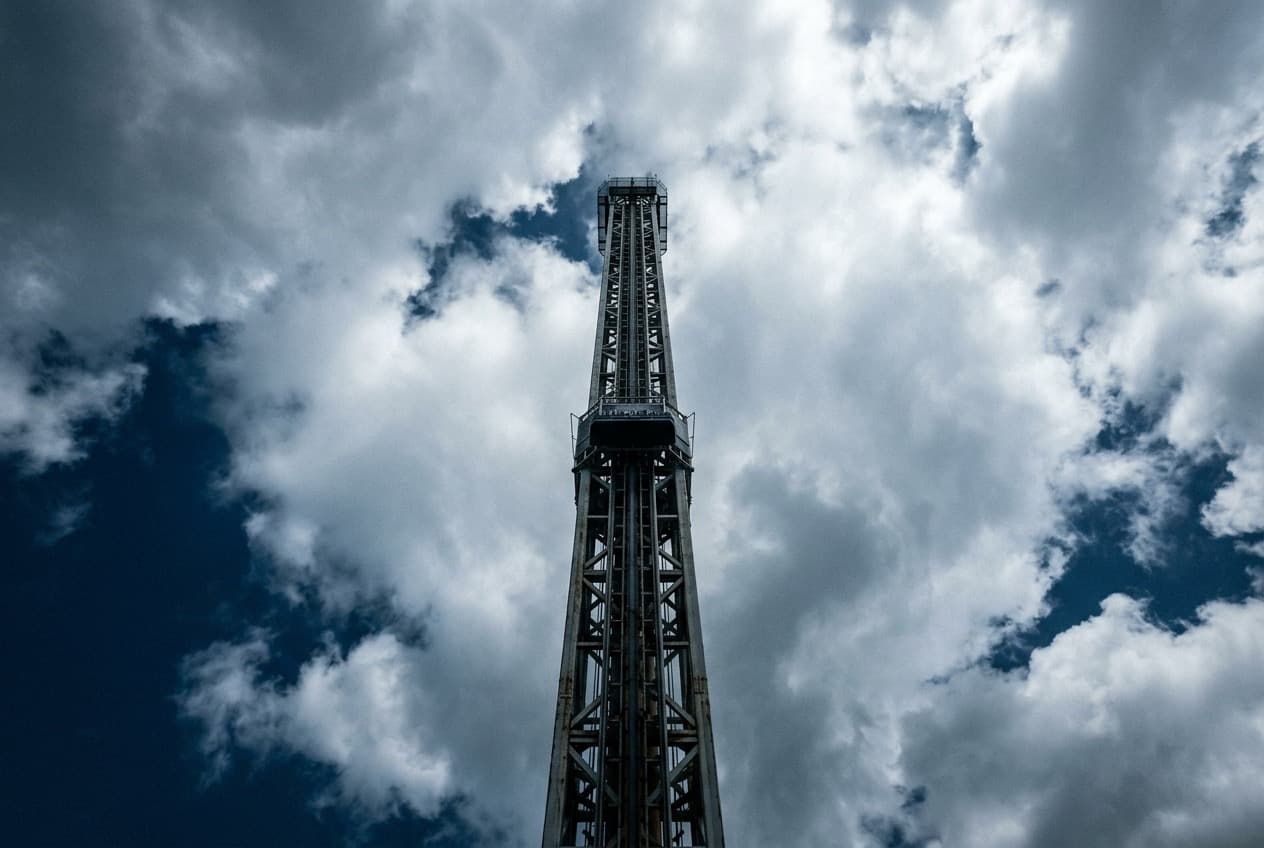
A drop tower is a vertical-axis amusement ride in which a passenger-carrying gondola is hoisted up a tower structure and then released, accelerating downward under controlled conditions before being decelerated, typically by linear induction motors (LIMs), eddy-current magnetic brakes, or a combination, before reaching the ground.
The engineering critical-path for rider safety on a drop tower has three phases:
- Lift phase. The gondola is hoisted to the top of the tower by a winch, chain, or pneumatic/hydraulic system. Rider restraints are checked and locked before the lift commences.
- Drop phase. The gondola is released and accelerates downward. During this phase, riders are weightless or near-weightless relative to the gondola. Restraints function passively because the rider is not pressed against them.
- Deceleration phase. The braking system slows the descent. Relevant engineering questions include the actual acceleration profile, rider position, restraint fit and whether the system operated within its applicable design and manufacturer requirements. These questions require ride-specific data rather than an unsourced typical force range. ASTM F2291 Scope
The deceleration phase is where restraint integrity matters most. A rider whose torso is not fully seated against the seatback at the moment of peak deceleration may experience separation between body and seat sufficient to cause the restraint geometry to disengage: in plain terms, the rider can slide upward and out from under a poorly-fitted lap-bar or OTSR.
Restraint Architectures
Modern drop towers use one of three restraint architectures:
- Lap-bar only. A pivoting bar across the rider’s thighs, latched into place by a ratcheted locking mechanism. Used on shorter drops and on rides where the seat geometry constrains rider posture.
- Over-the-shoulder restraint (OTSR), sometimes called a “horse-collar” restraint. A rigid, padded restraint that pivots from above the rider’s shoulders down across the chest. OTSR is the dominant restraint architecture on tall, high-deceleration drop towers.
- Combined OTSR + seat belt. A redundant secondary restraint (typically a fabric belt with a buckle) that connects the OTSR or lap bar to the seat frame and provides backup containment if the primary restraint disengages.
ASTM F2291 provides criteria and references for amusement-ride design. The actual restraint requirements depend on the relevant edition, applicable sections, manufacturer documents, ride characteristics and governing regulation. An engineering review should identify those requirements rather than infer a universal two-restraint configuration from the standard title. ASTM F2291 Scope
Sensor and Lock-Verification Systems
In addition to the mechanical restraint hardware itself, modern drop towers use a programmable logic controller (PLC) tied to sensors at each rider position. Before the ride dispatches, the PLC verifies:
- That each restraint has been locked into a position consistent with a seated rider (typically by reading a position sensor on the locking pawl or hydraulic ratchet);
- That manual operator-side lock-checks have been performed (in many ride control schemes, a ride attendant must press a confirmation switch);
- That the gondola’s structural and braking systems report ready.
When any of these signals is absent or anomalous, the PLC is designed to refuse dispatch. From a legal-discovery standpoint, the PLC’s event log (sometimes called the “ride black box”) is among the most important pieces of evidence in any restraint-failure case.
Rider-Size Verification
Drop tower restraint geometry is engineered to accommodate a defined population of riders, typically described by the manufacturer in terms of minimum and maximum height, minimum and maximum weight, chest and waist circumference, and (on newer rides) thigh dimension. When a rider falls outside the design envelope (for example, a rider whose torso is too thick to allow the OTSR to close to the locked position the sensor expects, or a rider whose seated waist is too narrow to be reliably constrained by the lap bar), restraint engagement may be marginal even when the locking sensor reports “locked.”
Following several high-profile fixed-site incidents in the early 2020s, ASTM F24 working groups, IAAPA’s Global Safety Committee, and several state regulators publicly intensified their focus on rider-size verification protocols, including objective measuring devices (“test seats”) at the queue entrance, redundant operator visual checks, and signage advising prospective riders of dimensional limits. The legal significance of this regulatory focus is two-fold: it has tightened the operational standard of care, and it has made operator deviation from rider-sizing protocols a more salient theory of negligence.
Talk to an attorney about a drop-tower injury →Call 833-236-8253
Restraint Failure Modes
Restraint failures generally fall into one of the following categories. The categorization matters because each failure mode aligns with different defendants and different liability theories.
1. Mechanical Restraint Failure
The hardware itself fails. A lap-bar latch fractures; a hydraulic ratchet leaks and back-drives under load; a pivot pin shears. Mechanical failures point primarily toward the manufacturer (design defect or manufacturing defect) and toward the operator’s maintenance program (negligent inspection / negligent maintenance), depending on whether the failure mode was foreseeable from design, present at manufacture, or developed in service.
2. Restraint Geometry / Rider-Size Mismatch
The restraint hardware functions as designed, but the rider’s body geometry permits separation under deceleration loads. The mechanism is usually that the OTSR or lap bar locks at a position that, while technically within sensor tolerance, leaves the rider with enough torso-to-restraint clearance to slide upward during the deceleration spike.
This failure mode implicates three distinct sets of duties:
- The manufacturer’s duty to design a restraint envelope (and corresponding rider-size criteria) that is actually safe across the full range of riders the restraint will permit to lock;
- The manufacturer’s duty to warn: to provide operators with clear, conspicuous, and quantitatively specific rider-size limits;
- The operator’s duty to enforce those limits at the queue (signage, test seats, visual verification, refusal of riders who do not fit).
3. Sensor / Lock-Verification System Failure
The hardware locks correctly but the PLC reports a false negative (preventing dispatch unnecessarily) or a false positive (dispatching with a restraint that is not in fact engaged). False positives are the dangerous failure mode. They can result from a mis-mapped sensor, a sensor whose tolerance band is too wide, a software defect in the PLC, or a maintenance-induced misalignment of a position sensor on a specific seat.
4. Maintenance-Induced Failure
A restraint that left the manufacturer in safe condition has, through poor preventative-maintenance practice, drifted out of safe condition. Common patterns include: lap-bar hydraulic units that have not been pressure-tested on the manufacturer’s recommended cycle; OTSR pivot bushings worn beyond service-limit tolerance; secondary belts replaced with non-OEM parts that do not meet load specifications; sensor positions disturbed during a non-restraint maintenance task and not re-verified.
5. Operator Override and Dispatch Errors
A trained operator either bypasses the dispatch interlock manually or dispatches the ride after a visual lock-check that did not in fact verify lock engagement at every seat. This is the cleanest operator-negligence theory, and it converges with negligent training and negligent supervision claims against the park operator.
Liability Theories in Restraint-Failure Cases
A well-pleaded drop-tower restraint failure complaint typically asserts multiple, alternative theories. Below are the principal ones and what each requires.
Operator Negligence
The standard tort negligence framework: the park operator owed a duty of care to the rider, breached the duty, the breach was a factual and proximate cause of the injury, and the rider sustained damages. In most jurisdictions the duty owed by an amusement-ride operator to a paying patron is at least the duty of reasonable care under the circumstances, with several states applying a heightened common-carrier standard (discussed below).
In a restraint-failure case, the operator’s duty subdivides into duties of:
- Reasonable inspection and maintenance of the ride and its restraints;
- Reasonable hiring, training, and supervision of operating personnel;
- Reasonable enforcement of rider-eligibility criteria (height, weight, dimensional, medical contraindications) communicated by the manufacturer;
- Reasonable response to known anomalies (incident reports, near-miss reports, manufacturer service bulletins, regulator advisories).
Manufacturer Product Liability: Design Defect
A drop-tower ride is a “product” within the meaning of products-liability law in essentially every U.S. jurisdiction. Under the Restatement (Third) of Torts: Products Liability § 2(b), a product is defective in design “when the foreseeable risks of harm posed by the product could have been reduced or avoided by the adoption of a reasonable alternative design by the seller . . . and the omission of the alternative design renders the product not reasonably safe.”
In drop-tower restraint cases, the reasonable-alternative-design analysis usually centers on:
- A different restraint architecture (for example, OTSR plus secondary belt instead of OTSR alone);
- A more conservative restraint locking-position (a tighter “locked” envelope that excludes a marginal rider rather than admitting them);
- A more accurate sensor system (multi-point position verification rather than single pawl-position sensing);
- Different rider-size criteria (criteria that more conservatively reflect the actual range of body geometries that the restraint will safely contain).
Many states have not adopted the Restatement (Third) wholesale and continue to apply some version of the Restatement (Second) § 402A “consumer expectations” or “risk-utility” tests, sometimes in combination. The substantive analysis usually lands in the same place (courts ask whether the product was unreasonably dangerous given the foreseeable use), but the formal pleading must track the law of the forum state.
Manufacturing Defect
A unit-specific deviation from the manufacturer’s own design specification: a particular lap-bar latch heat-treated incorrectly, a single OTSR pivot pin machined out of tolerance. Manufacturing-defect claims are often pleaded in the alternative to design-defect claims; on a properly-investigated case, metallurgical and dimensional inspection of the failed component drives the choice.
Failure to Warn
Inadequate warnings (to the operator, to the rider, or to both) can support a separate products-liability theory. Common failure-to-warn theories in drop-tower cases include:
- Inadequate or imprecise rider-size criteria delivered to the operator (for example, a single weight maximum without corresponding chest- or torso-circumference criteria, when the actual constraint on safe restraint is torso geometry);
- Inadequate warnings on the queue and load-area signage as to rider dimensional eligibility;
- Failure to update warnings via service bulletin or operator advisory after the manufacturer learns of a near-miss or in-service incident.
Negligence Per Se / Regulatory Non-Compliance
In jurisdictions that recognize negligence per se, an operator’s violation of a state ride-safety statute or implementing regulation may itself establish breach of duty for purposes of the negligence claim, leaving causation and damages as the only remaining factual issues. The doctrinal showing typically requires (a) violation of a statute or regulation, (b) that the plaintiff is in the class the statute was designed to protect, and (c) that the harm is of the type the statute was designed to prevent.
State amusement-ride safety regimes vary widely. Florida’s framework, administered by the Department of Agriculture and Consumer Services Bureau of Fair Rides Inspection under Fla. Stat. § 616.242 and Fla. Admin. Code ch. 5J-18, is one example; California regulates fixed-site rides through the Cal/OSHA Amusement Ride and Tramway Unit under the Amusement Rides Safety Law (Cal. Lab. Code §§ 7900 et seq., with the Permanent Amusement Ride program at §§ 7920–7932); Ohio regulates through the Department of Agriculture’s Amusement Ride Safety Division under Ohio Rev. Code §§ 1711.50–1711.99; New Jersey through the Department of Community Affairs under the Carnival-Amusement Rides Safety Act, N.J.S.A. 5:3-31 et seq.; and Pennsylvania through the Department of Agriculture’s Bureau of Ride and Measurement Standards under the Amusement Ride Inspection Act, 4 P.S. §§ 401–418.
For background on the federal-versus-state regulatory split that produced this patchwork, see our analysis at Florida’s Amusement Ride Safety Statute. The short version: in 1981, Congress amended the Consumer Product Safety Act to remove fixed-site amusement rides from the U.S. Consumer Product Safety Commission’s product-regulation jurisdiction (Pub. L. No. 97-35, 95 Stat. 724 (1981)), leaving CPSC authority over mobile/traveling rides only. Fixed-site rides, which include essentially all drop towers at major parks, are regulated, if at all, by the state.
Breach of Common-Carrier Duty
A small but doctrinally important set of jurisdictions, most prominently California, applies the heightened “utmost care and diligence” duty of a common carrier of persons to amusement-park ride operators.
The leading authority is Gomez v. Superior Court (Walt Disney Co.), 35 Cal. 4th 1125 (2005), in which the California Supreme Court held that the operator of a roller coaster (or “similar amusement park ride”) qualifies as a “carrier of persons for reward” under California Civil Code §§ 2100–2101 and accordingly owes its riders the highest degree of care for their safety. The holding has been applied by California courts to a range of mechanical rides that transport patrons under operator control.
California’s common-carrier duty applies to qualifying carriage, rather than every park activity. Gomez addresses roller coasters and similar rides; Nalwa distinguishes the participant-controlled bumper-car ride. The heightened duty remains tied to the character and practical operation of the conveyance and does not make the operator an insurer of passenger safety. Court Opinion 1 Court Opinion 2
Gomez and Nalwa distinguish different activities under California law. They do not establish a national count of states using a heightened amusement-ride duty. Check controlling authority for the actual state, ride or transport service. Court Opinion 1 Court Opinion 2
Inspection-Failure Liability Against State Agencies
In states with a public ride-inspection regime, plaintiffs sometimes consider claims against the state inspection agency itself for negligent inspection. These claims face several formidable doctrinal obstacles: state sovereign immunity (waivers vary), the public-duty doctrine (the proposition that a duty owed to the public generally is not owed to any specific member of the public), and tight statutory pre-suit notice requirements. They are not usually viable as a primary theory, but in the right factual posture (for example, where an inspector signed off on a known-defective restraint after a manufacturer’s service bulletin), they can sometimes survive as a contribution claim.
Discuss your case with an attorney →Call 833-236-8253
Defenses Park Operators Raise
Potential defenses should be evaluated alongside the evidence supporting liability.
Assumption of Risk
Operators frequently invoke primary assumption of risk: the doctrine that, for some inherently risky activities, the operator owes no duty to protect the participant from risks that are inherent in the activity itself. Knight v. Jewett, 3 Cal. 4th 296 (1992) is the foundational California formulation; the doctrine exists in some form in most jurisdictions.
Two important limits apply in drop-tower restraint cases:
- Nalwa v. Cedar Fair, L.P., 55 Cal. 4th 1148 (2012), which extended primary assumption of risk to bumper-car rides, explicitly preserves a duty not to “unreasonably increase the risk of injury over and above that inherent in the activity.” Restraint failure on a drop tower is not, by any sensible analysis, an inherent risk of riding the ride. The very purpose of the restraint is to reduce ejection risk to a level the engineering community considers acceptable; a restraint that fails to function is by definition operating outside its inherent design risk.
- The doctrine generally does not bar claims premised on operator or manufacturer conduct that increases risk above the activity’s inherent baseline: exactly the conduct at issue in a restraint-failure claim.
Contractual Waiver / Release
A printed waiver on the back of a ticket, an online click-through release, or an annual-passholder waiver document. Waiver enforceability is a state-law question and varies dramatically. New York’s General Obligations Law § 5-326, for example, voids waivers in recreational facilities where the patron has paid a fee. California enforces waivers for ordinary negligence but voids them for gross negligence under City of Santa Barbara v. Superior Court, 41 Cal. 4th 747 (2007). For a current state-by-state survey, see our resource at Waiver Enforceability by State.
Comparative Fault
In jurisdictions with comparative-fault regimes, the operator will typically argue some allocation of fault to the injured rider, usually framed as failure to follow ride instructions, misrepresenting weight or height at the queue, or unbuckling a secondary belt during the ride. Comparative-fault apportionment in restraint-failure cases is normally a jury question; the strength of the argument depends heavily on the available video and witness evidence.
Third-Party Conduct
Operators sometimes argue that a third party (a queue attendant employed by a separate staffing agency, a maintenance contractor, a non-OEM parts supplier) is the proximate cause of the injury and that the operator is at most a passive intermediary. This argument is rarely a complete defense; it is more often a fact pattern that brings additional defendants into the case under joint-and-several or pure-comparative apportionment principles.
Sole-Cause Arguments
Rider or third-party conduct can affect breach, causation, assumption of risk and allocation. Comparative-fault jurisdictions include recovery bars and exceptions; pure comparative fault does not guarantee recovery if another element fails or the plaintiff alone caused the harm.
Standards Bodies and the Industry Framework
A working understanding of who writes the rules is essential to any drop-tower case.
ASTM International F24 Committee on Amusement Rides and Devices
ASTM F24 is the consensus-standards body for amusement rides in North America. Its principal published standards relevant to drop-tower restraint analysis are:
- ASTM F2291, Standard Practice for Design of Amusement Rides and Devices. Addresses patron restraint, clearance envelope, containment design, acceleration limits, and structural design criteria. Restraint-redundancy provisions are central in drop-tower analysis.
- ASTM F770, Standard Practice for Ownership, Operation, Maintenance, and Inspection of Amusement Rides and Devices. Operations-side standard.
- ASTM F846, Standard Guide for Testing Performance of Amusement Rides and Devices: withdrawn in 2013 (last designation F846-92(2009)) and not replaced by a like-numbered successor; its performance-testing scope has effectively migrated into F2291 (design) and F770 (operations). Counsel encountering historical references to F846 in older operator manuals, manufacturer specifications, or inspection records should treat it as a withdrawn standard while still relevant to characterizing the engineering state of the art during the period it was active.
- ASTM F2374, addressing inflatable amusement devices (not directly relevant to fixed drop towers but often invoked in operator-training contexts).
ASTM F24 standards are voluntary consensus standards. They acquire legal force in two ways: by adoption by reference into a state ride-safety regulation (which the majority of states do, in varying degrees), and by their use as evidence of the engineering standard of care in negligence and product-liability litigation.
IAAPA Global Safety Committee
The International Association of Amusement Parks and Attractions (IAAPA) is the industry trade organization. Its Global Safety Committee publishes safety advisories, “Best Practices” documents, and member bulletins. IAAPA’s outputs are not law, but they are frequently introduced in litigation as evidence of what the industry knows or ought to know about a given hazard.
U.S. Consumer Product Safety Commission (CPSC)
CPSC regulates mobile and traveling amusement rides under the Consumer Product Safety Act. Following the 1981 amendment, CPSC has no direct product-regulation authority over fixed-site rides. CPSC continues to publish injury-surveillance data via the National Electronic Injury Surveillance System (NEISS) and occasional staff reports on amusement-ride injuries; these data sets are useful at trial as a public record of injury patterns.
State Regulators
State ride-safety regimes are the binding law on fixed-site rides. The agencies, statutory authorities, and operational rigor vary substantially by state. A non-exhaustive list:
- Florida: Department of Agriculture and Consumer Services, Bureau of Fair Rides Inspection, Fla. Stat. § 616.242; Fla. Admin. Code ch. 5J-18.
- California: Cal/OSHA Amusement Ride and Tramway Unit, Cal. Lab. Code §§ 7900 et seq. (Amusement Rides Safety Law); Permanent Amusement Ride program, §§ 7920–7932.
- Ohio: Department of Agriculture, Amusement Ride Safety Division, Ohio Rev. Code §§ 1711.50–1711.99.
- New Jersey: Department of Community Affairs, Carnival-Amusement Rides Safety Act, N.J.S.A. 5:3-31 et seq.; regulations at N.J.A.C. 5:14A.
- Pennsylvania: Department of Agriculture, Bureau of Ride and Measurement Standards, Amusement Ride Inspection Act, 4 P.S. §§ 401–418; regulations at 7 Pa. Code ch. 139.
- Texas: Department of Insurance, Amusement Ride Safety Inspection and Insurance Act, Tex. Occ. Code ch. 2151; regulations at 28 Tex. Admin. Code §§ 5.9001–5.9012.
A handful of states have effectively no fixed-site ride regulation, leaving the only restraint on ride safety to ASTM standards adopted via insurance contract and to the threat of civil litigation.
free case review →
Evidence Preservation in Restraint-Failure Cases
Drop-tower restraint-failure cases turn on physical and electronic evidence that begins to disappear within hours of the incident. The work of preservation begins as soon as counsel is retained, and ideally before, through a written preservation demand letter to the park, the manufacturer, and any maintenance contractor.
The Ride and the Restraint Hardware
The single most important piece of evidence is the physical seat and restraint at issue. A preservation demand should expressly direct the operator to:
- Sequester the involved seat, restraint hardware, and adjacent seats in their as-incident condition;
- Refrain from any maintenance, adjustment, parts replacement, lubrication, or cleaning of the involved hardware;
- Preserve all parts removed from the ride (including failed parts, broken fasteners, and hydraulic fluid samples).
State regulators conducting an incident investigation will typically have first access. Civil-side counsel should coordinate with the regulator to ensure that the regulator’s hold preserves evidence in a form that civil litigation can later examine.
PLC and Sensor Data
The ride control system’s event log is, in modern drop towers, a near-contemporaneous record of every dispatch, every restraint sensor state, every fault, and every operator input. PLC log retention is typically governed by ride-control firmware settings and by the operator’s IT policies. In some systems, the log buffer rolls over within days. A preservation demand should specifically call out:
- All PLC event logs covering a defined window before, during, and after the incident;
- All sensor diagnostic data;
- All ride-control firmware versions and any firmware update history;
- All operator login records and dispatch confirmations.
Maintenance Logs and Inspection Records
Daily pre-opening inspection records, weekly and seasonal maintenance records, work-order history for the involved ride (especially any restraint-related work order), and records of any non-OEM parts substitution. Most state regulators require operators to maintain inspection records for a defined period; subpoena reach to those records is straightforward in most jurisdictions.
Manufacturer Service Bulletins, Field Advisories, and Recalls
Did the manufacturer issue a service bulletin that addressed the restraint or sensor system at issue? Did the operator implement it? The answer drives both the negligent-maintenance theory against the operator and the failure-to-warn theory against the manufacturer.
Operator Training Records
Records of operator certification, refresher training, and ride-specific training. In a sensor-override or dispatch-error case, training-record gaps directly support the negligent-training theory.
Surveillance Video
Ask counsel promptly about preserving available surveillance footage, ride data and related records. Camera coverage, retention schedules and overwriting practices differ by operator and system. Preserve your own photos, tickets and witness details, and identify the ride, location and time so a preservation request can be specific.
Witness Statements
Other riders on the same dispatch, riders in the immediately preceding and subsequent dispatches, queue attendants, ride operators on shift, and any safety personnel who responded. Witness recollection degrades quickly; counsel should preserve statements promptly.
Regulatory Investigation Records
State regulator incident files are often available via public-records requests, subject to pending-investigation withholdings. Whether to request them early (potentially alerting the operator) or later (after the regulatory investigation concludes) is a strategic call that depends on the procedural posture.
Statute of Limitations Urgency
Personal-injury filing periods vary by claim and jurisdiction. Separate notice, contract or repose rules may also matter.
- Florida: ordinary negligence generally has a two-year period under current Fla. Stat. § 95.11(5)(a). Chapter 2023-15, § 28 applies the amendment to causes accruing after the effective date of March 24, 2023. Earlier claims may follow the prior four-year rule; cutoff-date and claim-specific issues require individual analysis. See Ch. 2023-15, § 28, Laws of Fla. Section 30 is the act’s separate general filing-based transition.
- California: 2 years for personal injury under Cal. Civ. Proc. Code § 335.1.
- Texas: 2 years for personal injury under Tex. Civ. Prac. & Rem. Code § 16.003.
- New York: 3 years for personal injury under N.Y. C.P.L.R. § 214(5).
- Ohio: 2 years for bodily injury under Ohio Rev. Code § 2305.10.
- Pennsylvania: 2 years for personal injury under 42 Pa. C.S. § 5524.
- New Jersey: 2 years for personal injury under N.J.S.A. 2A:14-2.
Wrongful-death limitations may differ from the personal-injury period in the same state and may be tolled or accrued differently. Tort-claims-act suits against state-agency defendants (a relevant consideration where the inspecting state agency is a contemplated defendant) have additional, much shorter pre-suit notice deadlines, sometimes as short as 90 to 180 days.
The practical takeaway is straightforward: time-sensitive evidence and time-sensitive deadlines run in parallel. Counsel should be retained, and a preservation campaign initiated, as early as the family’s circumstances permit.
For a fuller breakdown, see Statute of Limitations by State.
Damages
Damages may include proven economic and permitted noneconomic losses. Fatal cases require a separate analysis of wrongful-death beneficiaries and any surviving claims. Punitive recovery, if available, has additional state-specific requirements. Related references: Wrongful Death Damages in Theme Park Cases.
Two sector-specific points deserve mention here:
- Multi-defendant apportionment. A restraint-failure case typically involves at least the operator and the manufacturer; often the maintenance contractor, the parts supplier, and the staffing agency are also before the court. Apportionment rules vary state-by-state and meaningfully affect plaintiff recovery in jurisdictions with several-only liability.
- Insurance information. Identify the potentially responsible entities and obtain the applicable policies, limits, exclusions and excess coverage. Available insurance varies by defendant and incident; do not infer policy limits from the size or brand of a park.
Regulatory Investigation vs. Civil Litigation: Different Standards, Different Goals
After a serious drop-tower incident, two distinct factual processes typically run in parallel: the state regulator’s incident investigation and (potentially) the civil lawsuit.
A regulatory investigation and a civil injury claim address different questions and may involve different procedures and remedies. Their timing depends on the agency, claims, available evidence and court process; do not assume that an agency investigation ends within a fixed 60–180-day window.
A regulatory finding of non-violation is not preclusive of civil liability. The civil duty of care is generally broader than statutory minimum compliance, and many liability theories (design defect, failure to warn) sit outside the regulator’s jurisdiction entirely. Conversely, a regulatory finding of violation is often admissible (subject to state-specific rules) as evidence of breach in the civil case.
Implications for Future Drop Tower Safety
Three trends are reshaping the operational and legal landscape for drop-tower safety, as of the 2026 publication of this analysis:
- Tightened rider-size verification protocols. Following the early-2020s focus on rider-fit failures, ASTM F24 working groups, IAAPA, and several state regulators have moved toward more objective dimensional verification at the queue (test seats, calibrated measuring stations, redundant operator sign-offs). Operator deviation from these tightened protocols is, increasingly, a clean negligence theory.
- Sensor and software transparency. The opacity of proprietary ride-control firmware has become a recurring discovery battleground. Plaintiffs’ counsel are increasingly successful in obtaining source code review under appropriate protective orders.
- Manufacturer post-market surveillance obligations. The plaintiffs’ bar and several regulators have pressed manufacturers toward more rigorous post-market data collection: incident reporting back to the OEM, mandatory service-bulletin compliance, and updated warnings as the operating population diverges from the as-designed population.
These trends inform not only new-ride design but also the standard of care that courts will apply to in-service rides over the coming decade.
How Our Firm Approaches Drop-Tower Restraint-Failure Matters
Drop-tower cases are technical, multi-defendant, and time-sensitive. They typically require:
- Engagement of an amusement-ride engineering expert and a restraint-system biomechanics expert at the outset;
- A formal preservation campaign to the operator, the manufacturer, the maintenance contractor, and any third-party staffing agency;
- Coordination with the state regulator’s investigation (without surrendering civil-discovery prerogatives);
- Detailed records work: PLC logs, maintenance histories, operator training files, manufacturer service bulletins;
- Deep development of the multi-theory liability framework (operator negligence, manufacturer design defect, manufacturing defect, failure to warn, regulatory non-compliance) so that the case does not collapse if any single theory loses on summary judgment.
If you or a family member was injured, or you lost a loved one, you can request a free case review. Start with the location, approximate date and a brief summary. Evidence and legal deadlines can be time-sensitive. An inquiry does not create an attorney-client relationship; avoid sensitive documents until a secure follow-up is arranged.
free case review →
External Sources Cited
- ASTM International, F2291: Standard Practice for Design of Amusement Rides and Devices (latest edition).
- ASTM International, F770: Standard Practice for Ownership, Operation, Maintenance, and Inspection of Amusement Rides and Devices.
- Restatement (Third) of Torts: Products Liability § 2 (Am. L. Inst. 1998).
- Gomez v. Superior Court (Walt Disney Co.), 35 Cal. 4th 1125 (2005).
- Knight v. Jewett, 3 Cal. 4th 296 (1992).
- Nalwa v. Cedar Fair, L.P., 55 Cal. 4th 1148 (2012).
- City of Santa Barbara v. Superior Court, 41 Cal. 4th 747 (2007).
- Pub. L. No. 97-35, 95 Stat. 724 (1981) (CPSA fixed-site amusement-ride amendment).
- Florida Statutes Chapter 616.
- U.S. Consumer Product Safety Commission, NEISS injury-surveillance data.
- IAAPA Global Safety Committee, published safety bulletins and best-practices documents.
Attorney advertising. This page is for general informational purposes only and is not legal advice. Prior results do not guarantee a similar outcome.